When to switch funds, and when to stay put
You have a fund. You know how to compare it to alternatives. The remaining question is the practical one: should you switch, and if so, when? The marketing pressure from switching firms (סוכני פנסיה) is constant, and most of it is wrong. Two reasons to switch hold up under scrutiny. Four common reasons do not.
The two switch reasons that hold up
-
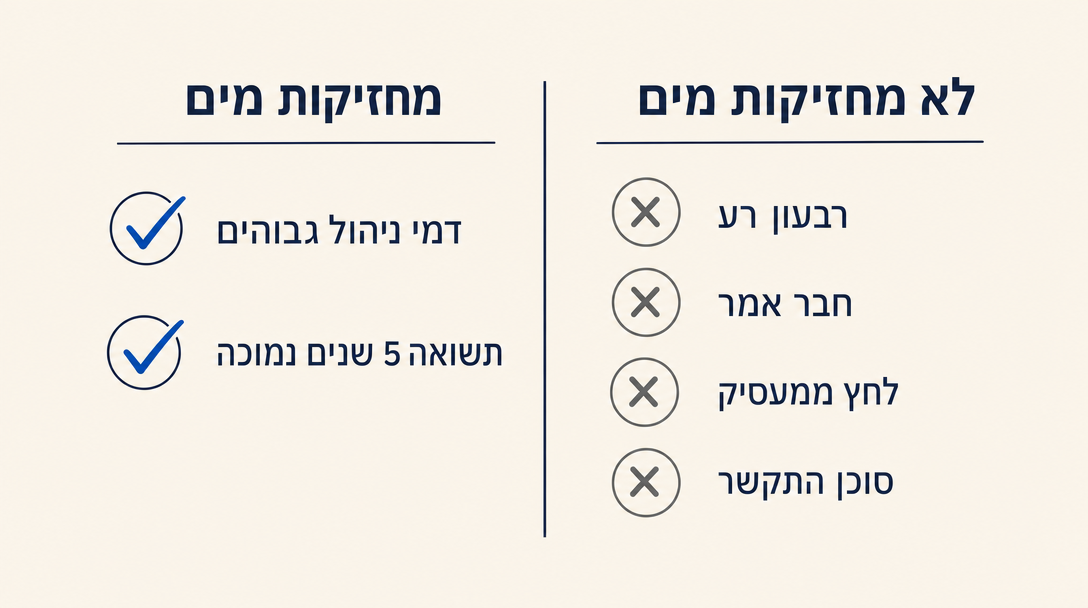
Your current fund's fees exceed the default-fund cap by a meaningful margin. If you are paying more than 1 percent on deposits or more than 0.22 percent on accumulation, and your fund is not delivering a 5-year cumulative return that beats the default cohort by at least 5 percentage points, the fee gap is taking money from you with no offsetting benefit. Switch.
-
Your 5-year cumulative return is more than 5 percentage points below the cohort leader in the same track. Funds report by track (general, equity, age-based 50- / 50-60 / 60+). Compare apples to apples. If your fund is more than 5 cumulative pp behind the same-track leader over 5 years and you have ruled out a structural reason (different equity exposure, different fee structure), management quality is meaningfully different and switching is warranted.
The four switch reasons that do NOT hold up
-
One bad quarter or one bad year. Markets cycle. A single 12-month underperformance is statistical noise, not signal. Wait for the 5-year cumulative number to confirm.
-
A friend, coworker, or family member said your fund is bad. They usually mean "their" fund is better, which is not a comparison. Ask them for the 5-year cumulative number for your fund AND theirs in the same track. They will not have it.
-
Your employer pressures you to move to a different fund. Employers in Israel cannot legally force a fund choice (since the 2008 פנסיה חובה extension order). They can have a "workplace default," but you may opt for any approved fund. If pressure persists, the Ministry of Labor (משרד העבודה) takes complaints.
-
A pension agent (סוכן פנסיה) cold-called you with a "limited-time offer" on management fees. Every fund will negotiate fees with a credible threat to switch. Get the offer in writing, then call your current fund and ask if they will match. They usually will.
The "leave it to my adult kids" mistake
A common misconception, especially among Israelis without minor children or a spouse: "my pension will go to my adult kids as inheritance when I die." That is not how the survivor mechanism works.
If you die before retirement and have no eligible survivors (no spouse, no minor children, no disabled adult orphan, no dependent parent), your accumulated savings convert into a lump sum, NOT into a monthly survivor pension. The lump sum goes to your designated beneficiaries (the form mentioned in Chapter 2). If you never designated beneficiaries, it goes to your legal heirs via court order (צו ירושה or צו קיום צוואה), which incurs court and lawyer fees that vary widely (from minimal for a self-filed uncontested case to substantially higher if anyone contests) and typically takes months to complete.
Adult kids will eventually receive the lump sum if you name them. They will NOT receive a monthly survivor pension because adult children are not in the eligible-survivor list. The fund is a retirement and disability-and-survivor product, not an estate-planning vehicle. If you want to leave assets to adult children efficiently, do it through a separate kupat gemel (provident fund), a savings policy (פוליסת חיסכון), or non-pension financial assets where the inheritance mechanism is simpler.
What happens at a job change
A job change is the most common moment Israelis revisit their pension. Three things move (or do not move) automatically:
- Your fund follows you, automatically. Your pension fund account is yours, not your employer's. When you switch jobs, your new employer continues contributions to the SAME fund unless you actively request a transfer to a different one. Your accumulated balance does not reset.
- Severance handling depends on Section 14 (see Chapter 1 if you skipped it). On a Section 14 employer, what is already in your severance sub-account is yours, period. On a non-Section 14 employer, you may negotiate a severance settlement at the time of separation, which can land in the severance sub-account or as a separate payment.
- Disability and survivor coverage continues as long as contributions continue. A gap in employment (e.g., two months between jobs) is the risky moment: brief gaps usually do not break coverage, but extended ones can re-open the underwriting clock under your fund's תקנון. If you expect a gap longer than a few weeks, ask your fund about a "risk-only continuation" (המשך ביטוח) so you stay covered without making full contributions.
The decision point at a job change: should you take the opportunity to switch funds (since you are revisiting the topic anyway)? Apply the framework above: only switch if you are paying more than the default-fund fee cap AND your 5-year cumulative return is meaningfully below the cohort. A job change is a convenient moment to switch; it is not a reason to switch by itself.
What actually happens at retirement
The course has focused on the pre-retirement period: choosing, contributing, monitoring. The retirement event itself has its own mechanics worth understanding before you reach it.
The eligible retirement age is 67 for men and 62-65 for women (rising on a published schedule toward 65 for women born after specific cutoff years). At eligible age, you have three choices:
- Convert to a monthly pension (קצבה). Your accumulated savings are converted using the actuarial conversion factor (מקדם המרה). If your savings are ₪1,500,000 and your factor is 220, your monthly pension is roughly ₪6,818 (₪1,500,000 / 220). The factor depends on your age at retirement, life expectancy at that age, and whether you elect a guarantee period for your spouse.
- Lump-sum withdrawal (היוון קצבה). A portion of the accumulated balance can be withdrawn as a lump sum. The exact percentage and tax treatment depend on the date you started contributing, the size of your retirement balance versus the קצבה מזערית (minimum pension floor), and your other pension assets. The lump sum is taxed under its own schedule, which differs from the monthly-pension taxation.
- Combination. Take part as a lump sum and convert the rest to a monthly pension. Most retirees do some version of this.
The monthly pension is taxed as ordinary income, with the elderly tax credit (זיכוי גיל) applied. The lump sum has a separate taxation track that takes into account your tenure and the period over which contributions accumulated.
Two timing decisions that materially affect the outcome:
- Defer retirement past the eligible age. The conversion factor improves (you have fewer expected years of payout), so your monthly pension is larger per shekel saved. Common move for those who can keep working and want to maximize income later.
- Re-think the track in the last 5 years. Some funds glide your allocation to more conservative tracks automatically as retirement nears. Some retirees benefit from staying in a higher-equity track longer; others prefer the conservative glide. This is the textbook conversation to have with a licensed יועץ פנסיוני before age 60, not at age 67.
When to consult a licensed pension advisor (יועץ פנסיוני)
This course covers the strategic framework. There are five situations where the framework is not enough and you should pay for one or two hours of a licensed יועץ פנסיוני's time:
-
You are leaving Israel for more than three years (relocation, retirement abroad, or extended sabbatical). The interaction with אזרח חוזר / תושב חוזר rules and the question of redeeming versus freezing your fund is complex.
-
You are considering switching mid-career and you have a pre-existing medical condition that might re-open in underwriting.
-
You have a blended family (children from multiple marriages) and want to structure beneficiary designations to protect specific dependents.
-
You are within 5 years of retirement and need to model the conversion factor (מקדם המרה) under different scenarios (lump sum vs. monthly pension, with vs. without spouse guarantee period).
-
You are self-employed with income variance higher than 30 percent year-over-year and need to plan the tax-stack contribution timing.
For situations 1-4, ask the advisor to provide their license number (license type: יועץ פנסיוני, regulated by the Capital Markets Authority). For situation 5, an accountant (רואה חשבון) is usually the right starting point, with a pension advisor as a second opinion if the numbers are large.
Closing note
This course is education, not investment advice. The frameworks teach you how to think about your pension; they do not tell you which specific fund or track to choose. The 2026 numbers in this course (average wage, contribution rates, fee caps, tax benefit ceilings) are accurate as of publication and will be updated each January when Bituach Leumi republishes the average wage. For the recurring conversation as your situation changes (new job, kids, divorce, leaving Israel), come back to israeli-pension-advisor at https://agentskills.co.il/skills/israeli-pension-advisor and chat with it. The course is what you read once; the skill is what you query repeatedly.
For the government-side layer of your retirement income (Bituach Leumi's קצבת זקנה, eligibility ages, kollel impacts, foreign-residence rules), israeli-bituach-leumi is at https://agentskills.co.il/skills/israeli-bituach-leumi. For verifying your monthly payslip deductions match what the fund actually received, israeli-payroll-calculator is at https://agentskills.co.il/skills/israeli-payroll-calculator. Each tool answers a different question; together they cover the full ground.
Companion skills
The course covers the strategy. These skills do the mechanical work of calculation and verification. Install them in your AI assistant and revisit them whenever your situation changes (new job, kids, divorce, leaving Israel).
- Israeli Pension Advisor (
israeli-pension-advisor), optimal keren hishtalmut and pension contribution amounts, plus Tikun 190 and form 161 handling. Install:npx skills-il add skills-il/tax-and-finance/israeli-pension-advisor - Israeli Bituach Leumi (
israeli-bituach-leumi), the government layer: old-age pension, eligibility ages, and returning-resident rules. Install:npx skills-il add skills-il/government-services/israeli-bituach-leumi - Israeli Payroll Calculator (
israeli-payroll-calculator), verifying that monthly payslip deductions match what the fund actually received. Install:npx skills-il add skills-il/accounting/israeli-payroll-calculator - The Israeli Freelancer Year (
israeli-freelancer-year), a companion course for the self-employed who need to time keren hishtalmut contributions alongside their mkdamot strategy. Install:npx skills-il add skills-il/courses/israeli-freelancer-year
Want to keep reading?
Sign in to unlock the rest of the course and track your progress.