What pension actually buys you
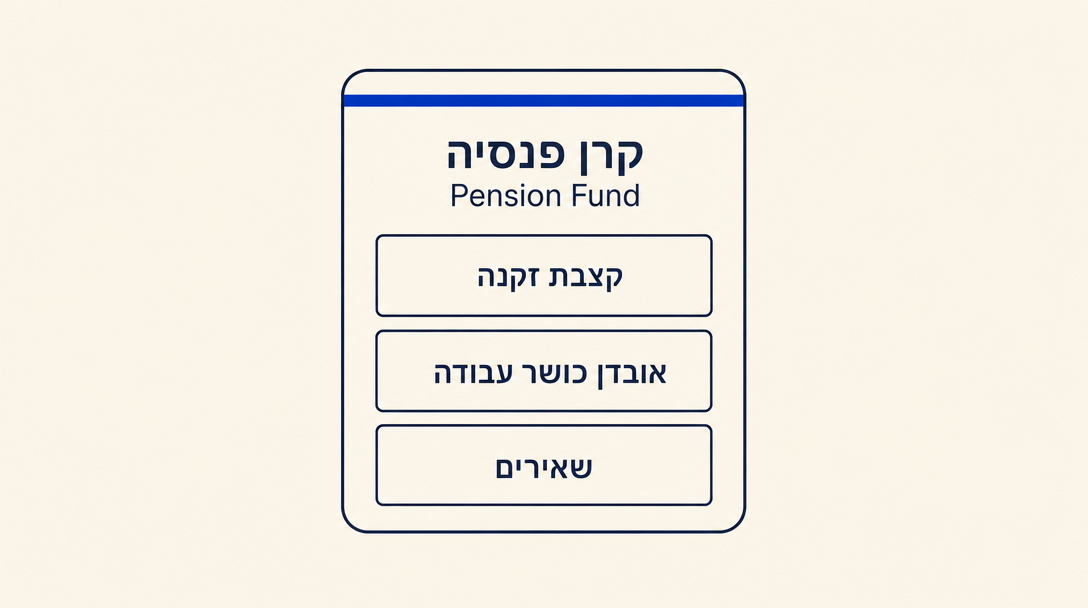
Every pension fund in Israel is three financial products fused into one container. Most people think they bought a retirement account. They actually bought a retirement account plus disability insurance plus survivor benefits, all priced as a package and all governed by one regulator (רשות שוק ההון, ביטוח וחיסכון, the Capital Markets, Insurance and Savings Authority).
The three products inside every pension fund
-
Retirement income (קצבת זקנה in the fund context, distinct from Bituach Leumi's קצבת זקנה). When you stop working, the fund converts your accumulated savings into a monthly payment using an actuarial conversion factor (מקדם המרה). The factor depends on your age at retirement, life expectancy, and whether you elected a guarantee period for your spouse.
-
Disability insurance (ביטוח אובדן כושר עבודה). If you become unable to work, the fund pays a monthly disability allowance. The regulatory cap is 75 percent of your insured salary, but actual coverage in practice is lower: the fund's payment is coordinated (תיאום) with any disability benefit you receive from Bituach Leumi (נכות כללית), so the combined gross payout cannot exceed the 75 percent cap. The premium is bundled by regulation; you cannot opt out, and it comes out of your monthly contribution automatically.
-
Survivor benefits (קצבת שאירים, pension fund version). If you die, your eligible survivors receive a monthly pension from the fund, paid for life or until the orphan turns 21. The eligible-survivor list and the rules are set by the Capital Markets Authority, not by your will. We unpack this in Chapter 2.
The cost of disability and survivor coverage is bundled inside the management fee on deposits. You cannot buy a "pension fund without insurance" in the Israeli market; the bundle is the product.
The claim mechanics for the disability product, briefly: if you become unable to work, you (or your family on your behalf) file a claim with the fund. The fund typically requires a medical assessment by their designated reviewers, which can take 60-120 days. Coordination with Bituach Leumi's disability benefit (נכות כללית) is automatic; you do not need to choose between them. If the claim is denied, an internal appeal exists, and a final appeal to the regional labor court (בית הדין האזורי לעבודה) is available.
Section 14 vs. the traditional severance arrangement
One of the most important employer-side decisions affecting your pension is whether your workplace is on a "Section 14 arrangement" (הסדר לפי סעיף 14 לחוק פיצויי פיטורין). Most modern Israeli workplaces are, but not all, and the difference shapes what happens at termination.
Traditional arrangement (without Section 14): the employer's 8.33 percent severance contribution accumulates in a separate sub-account inside your pension fund. When you leave the job (resignation or termination), the employer owes you a severance lump sum equal to one month's salary per year worked, calculated on your LAST salary at the time of separation. The amount already accumulated in the severance sub-account counts toward the obligation; the employer pays the difference (the השלמה) from their own pocket. This makes long-tenured separations expensive for employers.
Section 14 arrangement: the employer's 8.33 percent severance contribution is treated as full and final settlement of severance obligations. There is no השלמה owed at separation. What sits in your severance sub-account IS your severance. The trade-off: the amount reflects each year's contribution at the time, not your last salary. For employees whose salary grew substantially over their tenure, Section 14 can leave them with LESS severance than the traditional arrangement would have. For employees with relatively flat salaries, the two arrangements end up close.
How to know which one you are on: check your employment contract for a clause about הסדר לפי סעיף 14, or ask HR. Section 14 is opt-in per employer and once chosen typically applies to all employees of that employer.
The Israeli pension landscape in 60 seconds
| Product | Hebrew | What it actually is |
|---|---|---|
| Pension fund | קרן פנסיה (mostly comprehensive: מקיפה) | The default for almost every Israeli employee or self-employed person. Bundles retirement + disability + survivors. Governed by the Capital Markets Authority. |
| Manager's insurance | ביטוח מנהלים | A different financial product (life insurance with a savings component). The 2013 reform removed the guaranteed conversion factor (מקדם מובטח) for new policies, which made new ביטוח מנהלים much less attractive than a pension fund for most people. Old policies issued before the reform may carry a guaranteed conversion factor of 6-7 percent versus a current market factor closer to 3-4 percent; if you have such an old policy, that guarantee is extremely valuable and you should consult a licensed advisor before considering any switch. |
| Provident fund | קופת גמל | A tax-advantaged savings account. Does not include disability or survivor coverage. Common as a supplemental layer for self-employed and as the destination for severance pay (פיצויים). |
When this course says "pension fund," it means קרן פנסיה מקיפה (comprehensive pension fund). That is what virtually everyone reading this is in. The skill israeli-pension-advisor covers the differences in depth if you want the long version.
The 2026 numbers that anchor everything
The Israeli pension system is indexed to two numbers republished every January by Bituach Leumi (National Insurance Institute):
| Number | 2026 value | What it gates |
|---|---|---|
| Average wage in the economy, Section 2 (שכר ממוצע לפי סעיף 2) | ₪13,769 per month | Self-employed pension contribution bands, deduction caps, credit caps |
| Average wage, Section 1 (שכר ממוצע לפי סעיף 1) | ₪13,566 per month | Bituach Leumi benefit calculations (kiztavat zikna, dmei avtala, etc.) |
| Pension-eligible salary cap (employees) | ₪50,695 per month | Income above this is not subject to mandatory pension contributions |
You will see these numbers again in every later chapter. They flow through the whole system. The reason a self-employed person earning ₪82,614 pays a different rate than one earning ₪82,615 is because ₪82,614 is exactly half of (12 × ₪13,769) – the half-average-wage threshold.
The cost of "I will deal with this later"
The most common mistake: deferring the pension conversation for the first two years of your career. Here is what that actually costs.
A salaried employee earning ₪15,000 per month contributes 6 percent (₪900). The employer contributes 6.5 percent for pension plus 8.33 percent for severance, totaling 14.83 percent (₪2,224). Total monthly going into the pension: ₪3,124. Two years of not actively choosing a fund means two years inside whatever fund the employer picked as the workplace default. If that workplace default happens to be one of the four designated default funds covered in Chapter 3, fees are capped at 0.22 percent on accumulation and 1 percent on deposits. If it is NOT one of the four (some employers default to non-tender funds like Menorah, Migdal, or Harel), the fees can be substantially higher. Either way, two years of not checking the 5-year cumulative return your fund delivered is two years of compounding the wrong choice. Chapter 4 fixes that.
The fix for Chapter 1 is simpler: in the next 10 minutes, open your last payslip (תלוש משכורת), find the line that says "קרן פנסיה" or "פנסיה," and write down (a) the name of the fund and (b) the deposit percentage. You now know what you are in. Chapter 2 tells you whether it is the right shape for your life situation.