Tax season
Tax season isn't the time to make strategic decisions; it's the time to close out the previous year without losing anything. Every decision affecting your 2026 tax bill was made during 2026 itself. Tax season is a three-month window, January to April, when you document, file, and recover what's owed to you.
A tax-season schedule
| Date | Action | Mandatory / optional |
|---|---|---|
| January 15 | File December's VAT report | Mandatory for osek murshe |
| January 31 | File the annual VAT summary | Mandatory for osek murshe |
| February 15 | File January's VAT report (if monthly) | Mandatory for osek murshe |
| February to March | Collect all documents: 6111, 1301, bank records, expenses | Mandatory before April 30 |
| March | Choose: file solo or with an accountant | Personal decision |
| April 30 | File form 1301, the annual return to Reshut HaMisim | Mandatory for every self-employed |
| April 30 | Final mkdamot reconciliation for the previous year | Mandatory |
| May to June | Receive refund/credit if you overpaid mkdamot | Automatic |
Solo or with an accountant
The most significant decision of tax season. There's no single right answer, only rules of thumb:
When it pays to work with an accountant:
- Annual revenue above ₪200,000
- More than one income source (freelancer + employee, two businesses, active investments)
- Foreign income (even if small)
- Freelancers in regulated fields (medicine, psychology, financial advice)
- A year with a complex tax event (sold business vehicle, closed business, transition from murshe to company)
- Concerns about a books audit (if there was one in the past)
When solo works:
- Revenue up to ₪150,000 from a single source
- Simple, well-documented expenses
- No special tax events
- You have 4 to 6 free hours for collection and filing
Typical accountant fees for an active osek murshe in Israel run roughly ₪400-800 per month (₪5,000-₪10,000 per year) even for a simple file; osek patur files run lower. If they save you one missed credit or one obvious mistake, they pay for themselves. If you're a higher earner, the difference between working with one and not is usually ten thousand shekels plus on the tax bill.
What to collect before filing
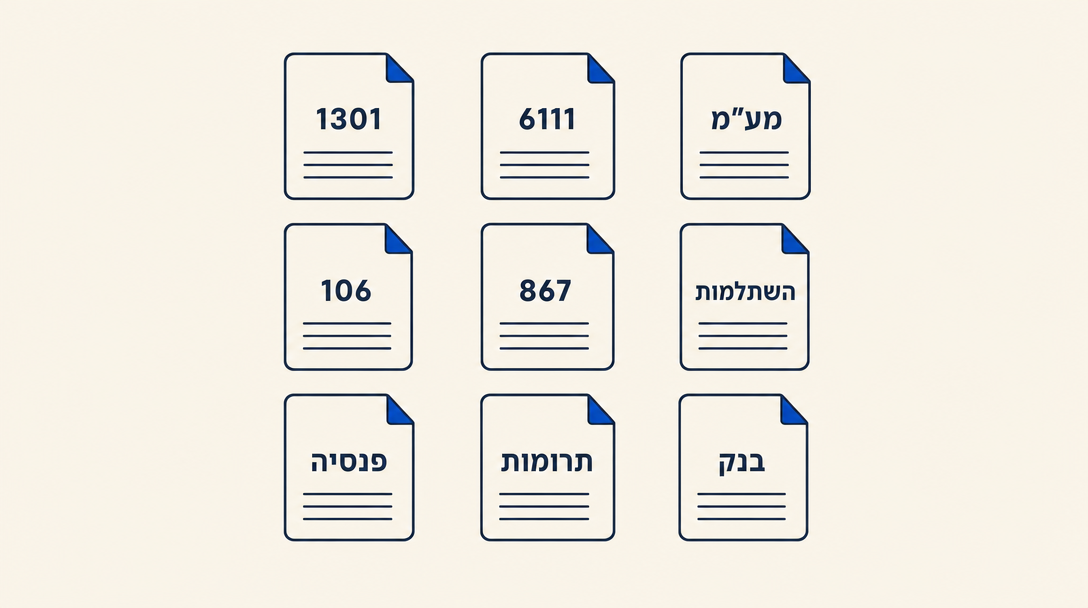
The standard list, even if you'll work with an accountant:
- Form 6111 from Reshut HaMisim's system (the annual financial report the system produces)
- VAT reports for every month (12 if monthly, 6 if bi-monthly)
- Business bank statements for the whole year
- Invoices you issued and the invoice files you received
- Keren hishtalmut and pension deposit confirmations (for the deduction calculation)
- Section 46 receipts for donations (each separately, with confirmation number)
- Form 106 from the employer, if you also had W-2 work
- Form 867 from the bank, if you have interest from deposits
- Previous year's form 1301, as a reference for numbers you had
The final calculation: mkdamot reconciliation
At the end of form 1301 there's a "mkdamot reconciliation" section. The number that comes out is the difference between:
- Tax that should have been paid based on the final taxable income for the year
- Mkdamot you actually paid during that year (sum of 12 monthly payments, or 6 bi-monthly)
If you paid more than required, you get a refund (credit). Refund timing varies. Files that go through clean can land in your bank account within 4-8 weeks, but files that trigger any review may take 3-6 months or longer.
If you paid less than required, there's a debt. Section 187 of the Income Tax Ordinance charges interest (currently 4% per year per Section 159a) plus CPI linkage on the unpaid balance, from the end of the tax year until you actually pay. The longer the gap, the more it compounds. This is exactly why a timely tikun mkdamot is critical (Chapter 3).
The most common mistake
The classic tax-season mistake: assuming the accountant knows everything. An accountant can compute correctly only what you give them. If you forgot to give them:
- Donation receipts (won't get the 35% credit)
- Confirmation of a keren hishtalmut deposit you made in December (won't deduct the amount)
- A supplier invoice issued in November without organized documentation (won't be included in expenses)
- Foreign income you forgot to mention. This is not just an audit risk: undeclared foreign income can trigger criminal exposure under Section 220 of the Income Tax Ordinance, and Israel exchanges financial data automatically with most other countries under CRS/FATCA, so the Tax Authority can cross-match. If you have any foreign income, do not file solo: work with a CPA who handles international files.
The fix: a checklist you go through together before they start filing. Anything you didn't show them is on you. An accountant won't remind you of what you don't know they don't know.
Skills to install for this chapter
- Israeli Tax Returns (
israeli-tax-returns), for filling form 1301, checking the mkdamot reconciliation, and identifying credits you didn't use. - Israeli Bank Connector (
israeli-bank-connector), for producing an organized expense list from your bank account ahead of filling out the return (even if the accountant will do the work, they'll work faster with an organized list).
What you should know after this chapter
- The tax-season schedule from January to April
- When solo works and when to engage an accountant
- The 9 document items to collect before filing
- Mkdamot reconciliation calculation and its tie to Section 187
You've finished the course. Next year you'll start it in Q1 with the frameworks you learned here: the four quarters, the 12 deadlines, the osek patur vs murshe decision, mkdamot strategy, expense optimization, end-of-year strategy, and tax season. The skills referenced throughout the course will do the mechanical work.
Where to go next
After completing this course, the skills in your catalog that will do the most heavy lifting in your year are israeli-freelancer-ops (operations and alerts), israeli-vat-reporting (every Doch Maam), israeli-tax-returns (mkdamot and the April 30 filing), and israeli-pension-advisor (keren hishtalmut contribution timing).
Specific government references you'll return to: gov.il/he/departments/taxes for Tax Authority filings, btl.gov.il for Bituach Leumi atzmai matters, and the Income Tax Ordinance itself for Section 17 (home office), Section 46 (charity), and Section 187 (late-payment penalty).
A note on this course
This course is informational and is not a substitute for advice from a licensed Israeli CPA (rohe heshbon) or tax advisor (yoetz mas). Get professional help any time you have foreign income, a business sale or restructuring, a regulated profession (medicine, psychology, financial advice), an active books audit, or any contested deduction position. Frameworks here are a starting point for your own thinking, not a substitute for someone licensed to file your return.
Companion skills
The course teaches the strategy and timing. These skills do the mechanical work of bookkeeping, reporting, and analysis. Install them in your AI assistant and reach for them in real time whenever you need to act.
- Israeli Freelancer Operations (
israeli-freelancer-ops), invoice-aging tracking, deadline alerts, and osek patur ceiling monitoring. Install:npx skills-il add skills-il/tax-and-finance/israeli-freelancer-ops - Israeli VAT Reporting (
israeli-vat-reporting), preparing and validating the Doch Maam every cycle, monthly or bimonthly. Install:npx skills-il add skills-il/tax-and-finance/israeli-vat-reporting - Israeli Tax Returns (
israeli-tax-returns), form 1301, mkdamot corrections, and identifying credits you missed. Install:npx skills-il add skills-il/tax-and-finance/israeli-tax-returns - Israeli Pension Advisor (
israeli-pension-advisor), keren hishtalmut and pension contribution timing based on your marginal tax rate. Install:npx skills-il add skills-il/tax-and-finance/israeli-pension-advisor - Israeli Bituach Leumi (
israeli-bituach-leumi), contribution rates, claim forms, and reporting for the self-employed. Install:npx skills-il add skills-il/government-services/israeli-bituach-leumi - Israeli Bank Connector (
israeli-bank-connector), bank transaction analysis and expense categorization ahead of the annual return. Install:npx skills-il add skills-il/tax-and-finance/israeli-bank-connector
Want to keep reading?
Sign in to unlock the rest of the course and track your progress.